
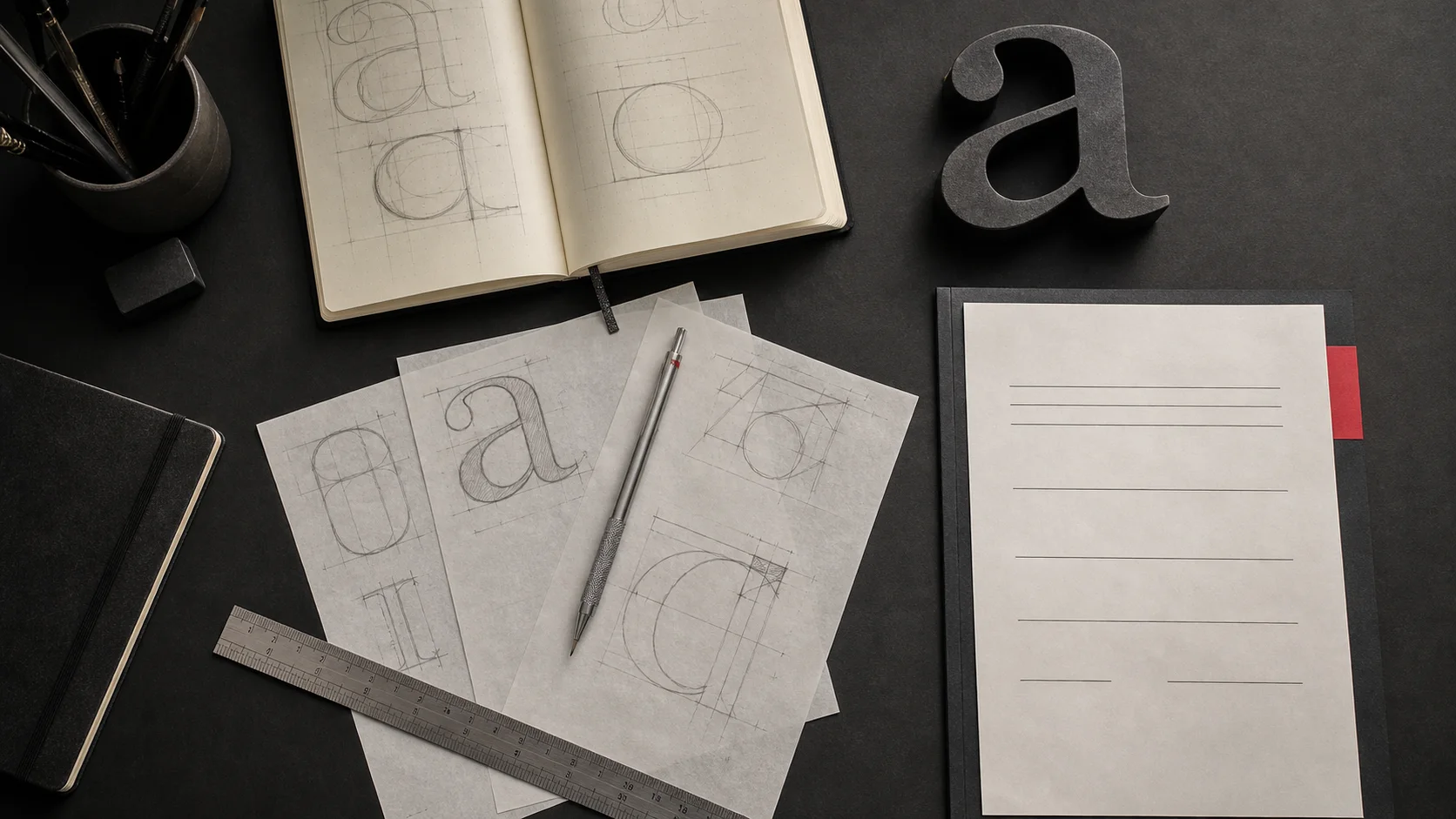
You can use a font in a logo when its license allows logo or commercial brand use. Many desktop font licenses include static logos. Other foundries sell a separate logo license, limit use to one named brand, or require extra permission for trademark registration. The EULA supplied with the font decides which rule applies.
Quick answer: find the original license, confirm that it covers logos and commercial work, check who may install the font, and keep the invoice with the brand files. Converting the finished wordmark to outlines can make delivery safer, but it does not replace the license used to create the logo.
At Typesee, logo and wordmark use requires a Brand / Logo License for one named identity. One implementation user is included for that task. Other foundries structure their licenses differently, so this guide explains the questions to ask rather than pretending one rule fits every font. This is practical licensing guidance, not legal advice.
Which font license do you need for a logo?
| Situation | Likely starting point | What to verify |
|---|---|---|
| You are designing one static logo or wordmark | Desktop or Brand / Logo license | Logo use, named brand limits, company size, and trademark rights |
| You are using a Google Font | The font’s open-source license | License file, reserved font names, and rules for modified font software |
| You are using Adobe Fonts | Active Creative Cloud access while creating the logo | Client editing, font access, and Adobe’s current service terms |
| The client wants editable source files with live type | License for every person who installs or accesses the font | Named licensee, user count, agency access, and transfer rules |
| The same font will be live text on the website | Web license in addition to logo rights | Domain, pageviews, hosting method, and supplied webfont files |
| The font will appear on merchandise or editable templates | Commercial Products or custom license | Units sold, customer personalization, and reusable glyph restrictions |
Start by separating the finished logo from every other brand use. A static logo placed on a website is still a finished graphic. Live headings rendered with the font require the font software to load in the browser, which is usually a separate Web use. Packaging, apps, templates, social campaigns, and film titles can add more categories.
If the project crosses several channels, use the broader decision process in Font Licensing Explained before buying.
Can you use a commercial font in a logo?
Yes, if the agreement permits it. A commercial font is not automatically licensed for every commercial project. The word “commercial” describes the purpose of the work, while the EULA defines the permitted users, media, scale, and technical uses.
Many foundries include finished logos in a normal desktop license. Some price logo rights separately because a brand identity can remain in use for years, be registered as a trademark, and appear across every part of a company. Neither model is universal.
Before presenting the design to a client, search the EULA for these terms:
- logo, logotype, wordmark, brand mark, or identity
- commercial use and client work
- trademark or registration
- modification of glyph outlines
- number of licensed users or workstations
- transfer, sublicense, contractors, and service providers
- prohibited products, templates, or letterform goods
If the wording is missing or unclear, ask the foundry in writing. Save the answer beside the invoice and license file. A short email from the rights holder is more useful than an assumption copied from a design forum.
How logo licensing works at Typesee
Typesee uses a separate Brand / Logo License. It covers a logo, wordmark, brand mark, or identity system for the one named brand on the order. The selected tier must match the organization’s size at the time of purchase.
The license includes one implementation user who may access the font to create that identity. A separate Desktop License is needed for general design work outside the named logo task, for work on another brand, or when additional people need to install or access the desktop font files.
The finished logo may be registered as a trademark where the law permits. Webfont embedding, apps, merchandise, editable templates, and delivery of the font software to a client are separate uses. Read the complete Typesee licensing terms before checkout.
Can you use free fonts in a logo?
Sometimes. “Free” tells you the price, not the permission. A free download can be open source, free only for personal work, a trial with a reduced character set, or an unauthorized copy of a paid font.
Google says every family in Google Fonts is available under an open-source license and can be used in a logo. Most use the SIL Open Font License, while some use Apache or Ubuntu font licenses. Check the individual family because the attached license still matters. The Google Fonts FAQ confirms commercial and logo use for fonts in its catalog.
The SIL Open Font License 1.1 allows the font software to be used, studied, modified, embedded, and redistributed under its conditions. It also says the font cannot be sold by itself and may protect a reserved font name. Those rules matter if you alter or redistribute the font software. They do not normally impose the same requirement on artwork created with the font.
Avoid building a permanent identity from a file found on an anonymous download site. Find the original designer or foundry, then keep the official license. Typesee’s free demo fonts are for evaluation, student work, and non-commercial personal portfolios. They do not cover a commercial logo or client pitch.
Can you use Adobe Fonts in a logo?
Adobe permits fonts activated through Adobe Fonts to be used for personal and commercial design work, including logos. Its current licensing FAQ also permits modifying type after it has been rasterized or converted to outlines. The resulting artwork may be used commercially or registered as a trademark, subject to applicable law.
A client does not need separate Adobe font access when you deliver a finished graphic or properly embedded document. The client does need their own license or subscription if they want to edit live type or use the font directly. These rules apply to fonts activated through Adobe Fonts, not every font installed on a computer. Read the Adobe Fonts licensing FAQ for the current service terms.
Does the client need their own font license?
The answer depends on what the client receives and what they plan to do next.
If the client receives only outlined SVG, EPS, or PDF logo files and never receives the font software, some licenses let the designer hold the working license. Other agreements require the client or named brand owner to be the licensee. Check that point before purchase, especially when an agency is buying for a client.
The client usually needs suitable font access when they will:
- open editable files that contain live type
- install the font on an employee’s computer
- create new headlines, packaging, presentations, or social posts
- send the font to another agency, printer, or contractor
- load the font as live text on a website
Do not place the OTF, TTF, WOFF, or WOFF2 files in a general brand handoff folder unless the agreement expressly permits transfer. Give the client the foundry link and explain which license they need for future typesetting.
Should you convert a logo font to outlines?
Usually, yes for final delivery. Outlining turns the typed wordmark into vector shapes. The logo keeps its appearance when opened on a computer without the font, and the client does not need the font file merely to place the finished mark.
Outlining does not legalize an unlicensed font. The designer installed and used the font before creating those shapes, so the correct license was still required at that stage. Outlining also does not grant permission to build a new font file, redistribute reusable glyphs, or sell an alphabet based on the typeface.

Use this file workflow:
- Save an internal master with live type and record the font name, version, foundry, invoice, and EULA.
- Duplicate the approved wordmark before converting it to outlines.
- Inspect counters, overlaps, strokes, and small details after conversion.
- Deliver outlined vector files and export formats suited to print and screen.
- Keep the font software out of the delivery package unless transfer is allowed.
Can you modify a font to make a logo?
Many licenses allow you to alter letters after converting the text to vector outlines or pixels. That can include changing terminals, joining letters, adjusting proportions, or drawing a custom character for the finished wordmark.
Editing the font software is a different action. Changing glyphs inside a font editor, renaming the family, generating a new OTF file, or sharing that modified file may need separate permission. Adobe draws this line clearly: outlined artwork can be modified, but users may not turn those outlines into new font software under the Adobe Fonts terms.
Read the EULA before modifying either the artwork or the source font. If the brand needs a full custom alphabet rather than one fixed wordmark, commission custom lettering or a custom typeface instead of stretching a logo license beyond its purpose.
Can you trademark a logo made with a font?
Trademark registration and font licensing answer different questions. A font license gives permission to use the font software. A trademark can protect a brand identifier in connection with particular goods or services. Registering a mark does not erase the font license, and buying a font does not guarantee that a proposed mark can be registered.
The United States Patent and Trademark Office distinguishes between standard character marks and special form marks. A standard character filing protects the wording without limiting it to a particular font, style, size, or color. A special form filing can protect stylized lettering, a design, or a logo in the form shown. The USPTO trademark examples explain the difference.
Trademark law varies by country, and conflicts with existing marks can block registration regardless of the font. Ask a qualified trademark professional about clearance and filing strategy. Ask the foundry about the font license. Keep those conversations separate.
Common logo font licensing mistakes
Assuming a purchased font includes logo rights
A receipt proves payment. The EULA states what was purchased. Check the logo and trademark clauses before the client approves the identity.
Using a personal-use font for a business
A logo for a company, paid creator channel, client, or monetized product is commercial work even when the designer made it as a favor.
Sending the font file with the logo
The logo artwork and the font software are separate deliverables. Outlined artwork may be shareable while the font file remains restricted.
Believing outlines replace the license
Outlines solve a production and handoff problem. They do not remove the need for lawful font access during design.
Using a logo license for every brand asset
A logo license may cover the fixed identity but not live website text, editable templates, merchandise, apps, or a paid campaign. Map each real use before launch.
Keeping no record of the license
Download links disappear and teams change. Keep the invoice, license text, font version, named licensee, permitted users, and written foundry answers in the brand archive.
A safer logo handoff for designers
Include a short licensing note in the handoff document. Plain language works better than a page of vague legal warnings:
The final logo files contain outlined artwork. The font software is not included. If your team wants to create new text with this typeface, purchase the appropriate license from the foundry before installing or using it.
Then record these details:
- font family, style, and version
- designer or foundry name and purchase link
- named licensee and licensed brand
- license category, user count, and purchase date
- invoice and EULA file location
- whether the client may edit live type
- future uses that need separate coverage
This record helps the client answer licensing questions years later without guessing which download or subscription produced the logo.
Logo font licensing FAQ
Do I need to buy a font to use it in a logo?
You need permission, which can come from a paid license, an open-source license, or another written agreement. The price can be zero, but the license still defines the permitted use.
Can I use a font marked “free for commercial use”?
Possibly. Find the original source and read the license file. Confirm logo use, modification, client work, and trademark rights. Do not rely on the label used by an unrelated download site.
Does putting a logo on a website require a webfont license?
A static logo image usually does not load the font software and may be covered by the logo agreement. Live website text rendered with the same typeface usually needs Web coverage.
Can I give the client an outlined logo without the font?
Often, yes. The designer still needs the correct license to create the logo, and the EULA must allow the finished artwork to be delivered. The client needs font access if they want to edit or create new live type.
Can two brands use the same logo font?
The typeface can appear in many brands unless the license grants exclusivity, which normal retail licenses rarely do. Each brand and user still needs the coverage required by the foundry.
Can I trademark an unmodified wordmark?
A trademark office may accept stylized wording or standard characters depending on the filing and jurisdiction. Registration eligibility is separate from the font license. Confirm both before launch.
Do I need a separate license for packaging?
The fixed logo may appear on packaging under its logo rights, but other text set in the font or packaging sold as a product may require Desktop or Commercial Products coverage. Check the EULA’s definition of each use.
Before the logo is approved
Confirm the font source, licensee, brand name, permitted users, logo rights, trademark clause, and every place the typeface will appear beyond the fixed mark. Put the invoice and EULA in the project archive before delivering the final artwork.
Browse Typesee fonts to test cinematic display typefaces with your own wordmark, then choose the Brand / Logo License that matches the organization. For unusual ownership, exclusivity, or multi-brand requirements, contact Typesee before purchasing.